Lasse Tynning
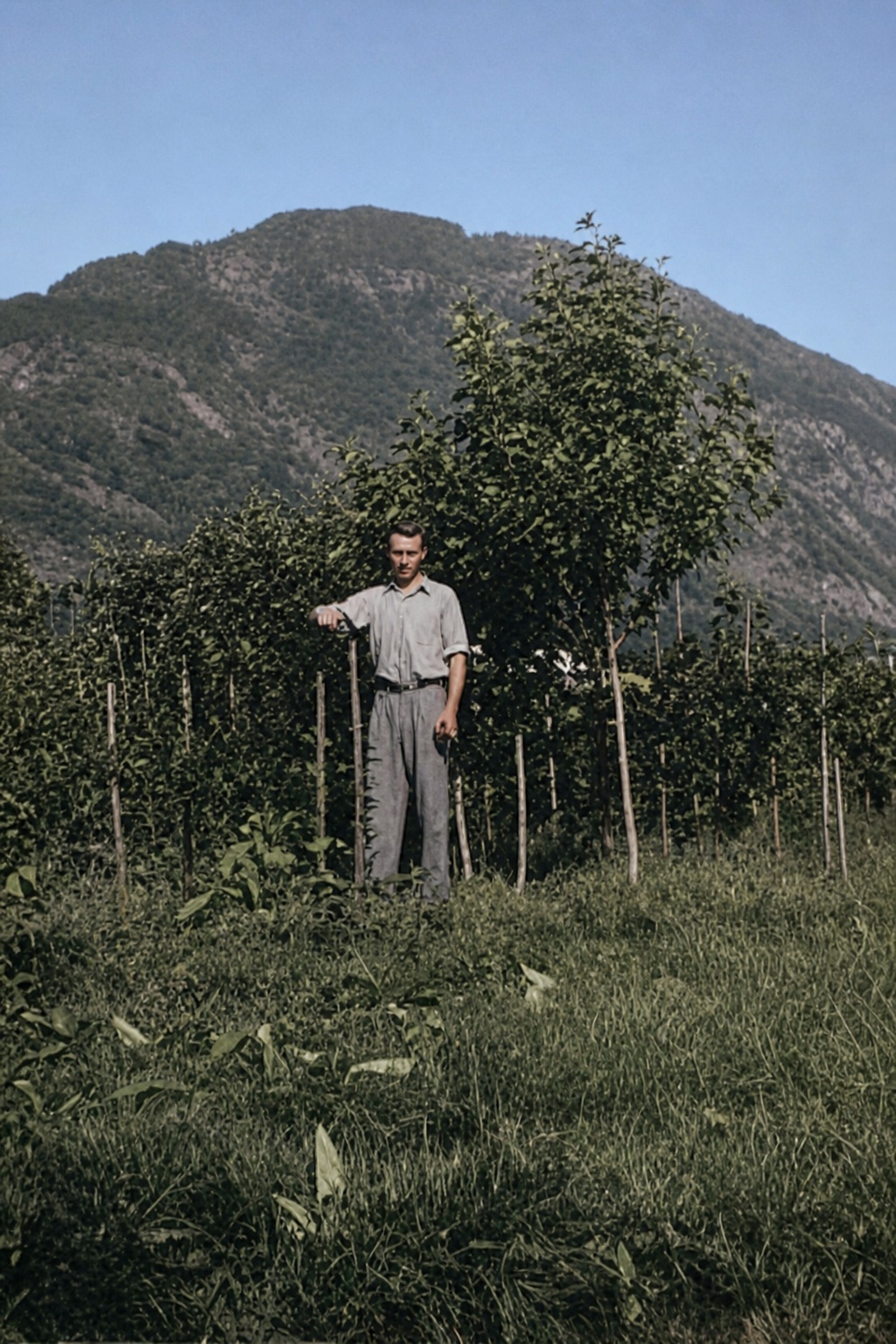
A later portrait of Lasse Tynning. The photograph has been restored and carefully colourised from the original.
The family archive. Date unknown.
The Pioneer
Lasse Tynning
b. 20 December 1898, Brekke – d. 10 October 1964, Porsgrunn
When the new municipality of Porsgrunn was to elect its very first conciliation board in December 1963, one name topped the list with the unanimous recommendation of the executive committee: Lasse Tynning of Eidanger. When Porsgrunns Dagblad in the autumn of 1972 wanted to tell readers what the women of Eidanger did when the war came, it was Åshild Tynning at Valler they sought out. She had kept the minutes. Between those two moments lies half a century in which the couple at Søndre Valler helped shape their community, from agriculture and schooling to politics and civil defence.
The story begins in Brekke in outer Sogn. On the farm Tynning, Lasse was born on 20 December 1898, the son of nursery owner Isak Tynning (1875-1960) and Brita, née Østerbø. His father started Tynning Planteskule and wrote about fruit growing in coastal districts, and the name Lasse had recurred on the farm for generations: his grandfather was Lasse Torstensen Tynning, born 1842. On the neighbouring farm Haugland, Åshild was born on 10 February 1897, daughter of Torstein H. Haugland.
Lasse was not only a farmer's son. He took examen artium, and in December 1920 he graduated from Sandved horticultural school near Sandnes with the best mark of seventeen pupils. At twenty he lectured in the temperance society and served as a delegate for the Sogn youth societies, and in the autumn of 1927 he wrote political pieces in Sogns Avis for the Farmers' Party. That spring he carried a 4,000-year-old stone axe, found in a ditch on his father's holding, to Bergen Museum. Then he bought a farm in Eidanger. There he sat on the land board from 1928, ran Valler Gartneri with apprentices, sold building plots at Vallermyrene in the 1930s and was deputy chairman of the Eidanger branch of Bygdefolkets krisehjelp in 1935.
Both were the kind of people who set things in motion. In 1919 Lasse was a delegate for the Sogn youth societies and lectured in the temperance society. Åshild took her teacher's exam at Stord lærarskule the same year and took her first post in Solund. Lasse attended commercial college in 1916, horticultural school in 1920 and took examen artium in 1926 — an unusually long education for a farmer's son at the time.
In 1928 Lasse bought the property Søndre Valler in Eidanger near Porsgrunn, and on 26 May 1928 he married Åshild in Brekke church. The church book shows that the groom already lived in Eidanger, while the bride came from a teaching post in Voss. The deed for the farm, 68 000 kroner, was printed in Breviksposten in January 1929. At Valler they ran a nursery and farm, and already in 1930 we find advertisements for "Valler Gartneri" in the local papers — the same year the young farmer made the national newspaper Nationen boil with his criticism of the new land law.
Both threw themselves into community life. Lasse became a driving force in Eidanger Landbrukslag, later Eidanger Bondelag, and served as chair for many years. Åshild became a teacher, from 1937 permanently at Tveten school, and the same year chair of Eidanger Husmorforening. He stood on the Farmers' Party lists for the municipal council, she sat on the popular enlightenment board. And in their free time they were a bridge partnership in the club Lasse helped found.
When war threatened in the winter of 1940, Kvinnenes Arbeidshjelp was established in Eidanger, and Åshild Tynning became chair of its agriculture committee. Together with the district agronomist she trained young women to take over farm work if the men had to go to war, with Valler as one of the practice farms. Lasse's war effort never appeared in the newspapers — and that was the whole point. After liberation he received a certificate of thanks from the Norwegian Armed Forces High Command's Office II, the Norwegian intelligence service in London, for the support he gave to intelligence work in the freedom struggle 1940-45.
Peace released enormous energy in both of them. In the autumn of 1945 Lasse was number three on the Farmers' Party's Storting list for Telemark. In February 1946 Åshild was elected first chair of the re-established Telemark Bondekvinnelag, a post she held until 1952, and in 1948 she joined the editorial board of Norges Bondekvinnelag. She spoke for farm women on NRK radio, raised women's property rights at national meetings and in 1956 won national press attention for the demand for barn assistants for farm wives. He wrote the jubilee book "Porsgrunn Meieribolag gjennom 50 år", sat on the board of the dairy and Telemark Landbruksselskap, led Telemark Bondelag's tax committee and was credited with the establishment of the Tax Office for agriculture and forestry.
Through the 1950s and into the 1960s Lasse Tynning was one of Eidanger's most prominent politicians. When Eidanger, Brevik and Porsgrunn were merged in 1964, he became the Centre Party group leader in the new city council and chair of the new conciliation board, where, according to the obituary, "with his rare ability to find ways to get the parties to settle he did a unique piece of work".
Lasse Tynning died quietly at St. Joseph's Hospital on 10 October 1964, only 66 years old. Obituaries appeared in newspapers across the country, and Porsgrunns Dagblad summarised: "In the Porsgrunn district, indeed in the whole of Telemark county, Lasse Tynning was an institution. He was the sharp oracle of the farming community, always well equipped with factual knowledge, an untiring fighter in the current social debate, combative and attentive, sharp as said, but not hasty. Lasse Tynning stood strong in many a public exchange of words; his opinions were heard whether one agreed with him or had a different view. He could also act as a breakwater, for he was understanding and tolerant."
Åshild continued on the school board and at the lectern until she retired in 1967, honoured for thirty years of teaching at Tveten school. She followed her sons onward: Torstein, who became a national politician, and Åsmund Lasse, who took over Søndre Valler from 1965. She died on 9 September 1974. Between them, Lasse and Åshild Tynning touched almost every trust a community has to offer: youth clubs, farmers' leagues, farm women's leagues, housewives' associations, school boards, municipal councils, city councils, tax boards and conciliation boards. They arrived from Sogn and ended up as the very glue of Eidanger. And the name lives on: the name Lasse has been handed down on the Tynning farm in Brekke since the early 1800s, and continues in the family today.
The gardener who bought a nursery property
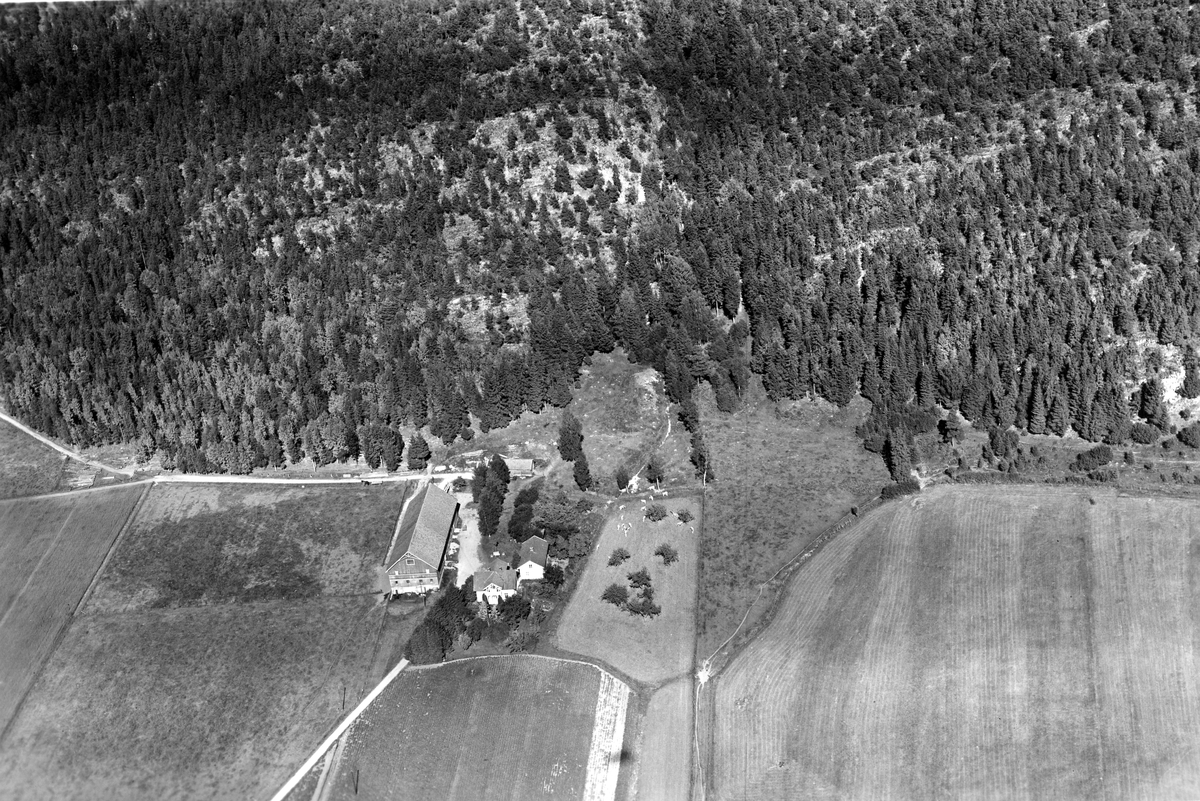
Søndre Valler was no random farm purchase. The gardener Mikael Aamot from Eidfjord in Hardanger bought Valler in 1908 and moved Aamot's horticultural school there in the autumn of 1909. He cultivated some sixty decares of bog, ran a nursery on the holding and planted around three hundred fruit trees. The parish history records that from 1908 onwards «many fruit trees» were planted, «among them an avenue of tall-stemmed apple trees along the road up to the farm». The grounds were later expanded to about fifty decares. The horticultural school closed in 1917, but the nursery continued.
When Lasse Tynning applied for a concession at the municipal council meeting on 7 February 1928, the parish history states that «there he was to run a nursery together with Aamot». The son of the nursery owner in Brekke thus bought a property already built for what he knew how to do. The price was 65,000 kroner, plus 3,000 for tools. The deed came in 1929, at 68,000 kroner. The holding covered 180 decares of cultivated land and 200 decares of outfield.
Gårds- og slektshistorie for Eidanger (1984), gnr. 44 bnr. 1 Søndre Valler.
About Bygdefolkets krisehjelp
Bygdefolkets krisehjelp ("Rural People's Crisis Aid") was founded in the autumn of 1931, in the worst debt crisis Norwegian agriculture has known. Farm prices had collapsed, debts had not, and thousands of farms were sent to forced auction. The movement demanded debt relief, lower interest and payment deferrals, and it actively resisted the auctions. It reached eight to twelve thousand members, most of them in Vestfold and Telemark, where the debt burden was heaviest. In Eidanger the local branch held its annual meeting in the fruit cooperative's cellar at Folkvang, and Lasse Tynning was deputy chairman of its first board.
The movement was short-lived and controversial. At the 1933 general election parts of it ran joint lists with Nasjonal Samling, and some of its leaders later went that way. It was dissolved in 1936. For most of its members, a newly established nurseryman in Eidanger with a mortgaged farm among them, it was about something far simpler: neighbours who would not watch each other's farms go under the hammer. What Lasse himself thought of the course the movement took, we do not know. What we do know is what he did when the real choice came: during the occupation he worked for the intelligence service, and after the war he received the diploma that hangs in the family archive.
Lasse in the newspapers
The newspapers follow Lasse from the young gardener who spoke up on land policy, through his work for the farmers' association and a living agriculture in an industrial parish, to the great municipal debates in Grenland. Here are four reports showing the range of his civic engagement.
1930
A land case in Eidanger
Only a short time after taking over Søndre Valler, Lasse was already a clear voice in the public debate on farming. Breviksposten reprinted his criticism of a ministry decision under the land act. The excerpt shows the opening and offers a concentrated glimpse of the factual, combative voice later known across Telemark.
Source: Breviksposten, 26 May 1930, page 1. The National Library of Norway.
See the full newspaper page at the National Library of Norway1947
Farming in an industrial parish – on NRK
On the initiative of Lasse and Eidanger Bondelag, the broadcasting service made a report on farming in a municipality profoundly changed by industry. In the interview Lasse placed farming, forestry, fishing, the ice trade and the new large industry in a single context. The article shows him as both local historian and spokesman for a living agriculture.
Source: Porsgrunns Dagblad, 19 June 1947, page 4. The National Library of Norway.
See the full newspaper page at the National Library of Norway1963
Has Skien stagnated?
In this long piece Lasse examined a government bill on the municipal mergers in Grenland. He discussed growth, population, business, trade and the relationship between the new municipalities. The clipping is shown in full height and can be opened in the lightbox to study the text.
Source: Porsgrunns Dagblad, 7 February 1963, page 7. The National Library of Norway.
See the full newspaper page at the National Library of Norway1964
The obituary for Lasse
When Lasse died in October 1964, Porsgrunns Dagblad printed an obituary with a portrait. The paper highlighted his knowledge, his great capacity for work, his part in public debate and his many offices. The image is an excerpt; the link opens the full newspaper page at the National Library of Norway.
Source: Porsgrunns Dagblad, 12 October 1964, page 3. The National Library of Norway.
See the full newspaper page at the National Library of Norway1964
The portrait in the obituary
Lasse Tynning. The portrait Porsgrunns Dagblad printed together with the obituary on 12 October 1964 – the first press photograph of Lasse found in open sources.
Facsimile: Porsgrunns Dagblad 12.10.1964 / The National Library of Norway (CC BY-NC-ND).
See the full newspaper page at the National Library of Norway1964
The family's death notice
The family's death notice: «Bonde Lasse Tynning, min kjære mann og vår gode far, døde stille i dag på St. Josephs Hospital etter en tids sykeleie, 66 år gammel. Valler, 10. oktober 1964. Aashild Tynning. Barna.» — Farmer Lasse Tynning, my dear husband and our good father, passed away quietly today at St. Joseph's Hospital after a period of illness, 66 years old.
Facsimile: Porsgrunns Dagblad 12.10.1964 / The National Library of Norway (CC BY-NC-ND).
See the full newspaper page at the National Library of NorwayDocuments
Short notices, advertisements and meeting reports fill out the life story. Together they follow Lasse from his education at Sandved, through the nursery and organisational work, to the political offices in the new Porsgrunn.
1920
Top of the class at Sandved horticultural school
The anniversary report from Sandved horticultural school lists the examination results of seventeen pupils. Lasse Tynning from Sogn has the best result.
Source: Stavangeren, 16 December 1920, page 4. The National Library of Norway.
See the full newspaper page at the National Library of Norway1928
The wedding in Brekke
The notice announces that the teacher Aashild Haugland and the gardener Lasse Tynning were to marry in Brekke on 26 May 1928.
Source: Sogns Tidend, 23 May 1928, page 2. The National Library of Norway.
See the full newspaper page at the National Library of Norway1930
Valler Gartneri at Porsgrunn market square
An advertisement for raspberries, blackcurrants and redcurrants documents that Valler Gartneri sold produce from its own cart at Porsgrunn market square. The advert carries Lasse's name and telephone number.
Source: Porsgrunns Dagblad, 22 July 1930, page 5. The National Library of Norway.
See the full newspaper page at the National Library of Norway1931
Farm hand and gardening apprentices
Valler Gartneri advertised for a farm hand and two gardening apprentices, a boy and a girl. The short advert gives a concrete picture of the work and training at Valler.
Source: Nationen, 10 March 1931, page 8. The National Library of Norway.
See the full newspaper page at the National Library of Norway1935
Bygdefolkets krisehjelp
The annual meeting report shows that Lasse had first been deputy chairman and was then elected to the new board of Bygdefolkets krisehjelp in Eidanger.
Source: Porsgrunns Dagblad, 4 February 1935, page 2. The National Library of Norway.
See the full newspaper page at the National Library of Norway1947
Eidanger Bondelag turns 30
At the anniversary celebration Lasse, as chairman, gave an overview of the association's first thirty years. The article also shows Åshild as county chair of Telemark Bondekvinnelag.
Source: Porsgrunns Dagblad, 22 April 1947, page 5. The National Library of Norway.
See the full newspaper page at the National Library of Norway1949
Anniversary publication on Porsgrund Meieribolag
For the dairy company's fiftieth anniversary an anniversary publication written and edited by Lasse was issued. The article also looks back on the history of dairying in Porsgrunn.
Source: Telemark Arbeiderblad, 4 February 1949, page 4. The National Library of Norway.
See the full newspaper page at the National Library of Norway1952
Elected by twenty-seven votes to four
Eidanger Bondelag proposed Lasse as a member of the tax assessment board with expertise in farming. The council elected him by twenty-seven votes to four, and the report also shows the lively debate during the other elections.
Source: Porsgrunns Dagblad, 28 January 1952, page 5. The National Library of Norway.
See the full newspaper page at the National Library of Norway1963
The naming meeting for the new municipality
The naming meeting for the new enlarged municipality, January 1963. At the far left of the hall sits Lasse Tynning with folded arms, next to Sigurd Langangen.
Facsimile: Porsgrunns Dagblad 9.1.1963 / The National Library of Norway (CC BY-NC-ND).
1963
Lead candidate for the Centre Party
The front-page report shows Lasse at the top of the Centre Party's nomination list for the first council of the new enlarged municipality of Porsgrunn.
Source: Porsgrunns Dagblad, 10 July 1963, page 1. The National Library of Norway.
See the full newspaper page at the National Library of Norway1963
Chairman of the conciliation board
The new city council elected Lasse a member and chairman of the conciliation board for the merged Porsgrunn. The notice documents one of his last major public offices.
Source: Porsgrunns Dagblad, 2 December 1963, page 3. The National Library of Norway.
See the full newspaper page at the National Library of NorwayThe clippings are cropped, restored and scaled for legibility. Photographic parts of two clippings have been gently digitally colourised; the colours are indicative. The newspaper text and layout are unaltered. Source: The National Library of Norway.
Sources
Brekke herred: ei bygdebok vol. 2 (1944); the 1920 census (Digitalarkivet); Stavangeren 16.12.1920; Sogns Tidend 23.5.1928; Gula Tidend 12.4.1927; Sogns Avis 31.7.1945; Norig 17.9.1928; Nationen 10.3.1931; Porsgrunns Dagblad 4.2.1935, 12.12.1936, 4.12.1937; Dagbladet 28.5.1937; University Museum of Bergen B7815; Fylkesarkivet i Vestland (photo archive).
From the family archive
Lasse and Åshild – the wedding in 1928
Lasse and Åshild – the wedding in 1928
Lasse Tynning and Åshild Haugland on their wedding day in 1928. Åshild is dressed in traditional bridal attire with a bridal crown.
Restored and colourised historical photograph. The family archive.
Young people in Brekke, c. 1923
A "Sunday line-up", probably by the quay in Brekke, with the newspaper and post collected from the steamer. Standing from left: Hans Søgnen, Lars Tynning, Leif Oppedal, Gerhard Tynning, Lasse Tynning (in a hat, newspaper under his arm), Olav Underdal and Kristoffer Vikne. Seated from left: Sigrid Tynning, Lise Engesæter, Dagny Haugland, Aashild Haugland, Ingeborg Haugland and Ingrid Haugland. Lasse and Aashild thus appear in the same picture years before they married. The archive dates it c. 1925, but Lasse's sister Sigrid died in May 1923, so it must be older.
Photo: Vestland County Archives, SFFf-1994102.0021. Photographer: Botolv H. Tynning. Colourised by the family, 2026.
Sunday outing to the Haugland summer farm, c. 1925
Young people and children from the Haugland farms in front of one of the huts at the summer pasture, ten kilometres up in the hills. Aashild's brother Olav Haugland plays the accordion. Both Lasse Tynning and Aashild Haugland are in the picture, with six of her siblings, but the archive has not recorded who is who. The local history book notes that sprat fishermen with Sunday off would walk up to the summer farm to meet the dairymaids.
Photo: Vestland County Archives, SFFf-1994102.0053. Photographer: Botolv H. Tynning. Colourised by the family, 2026.
The couple and their parents, 1928
Detail from the wedding photograph. Lasse in a hat, Aashild wearing the crown. To the right of the bride her mother Anna Haugland; to the left of the groom, according to the archive's numbering, his mother Brita and father Isak.
Photo: Vestland County Archives, SFFf-1993366.0007. Colourised by the family, 2026.
Vallermyrene from the air, 1961
The housing estate by Eidanger station, photographed by Widerøe on 15 June 1961. The plots here were parcelled off from Søndre Valler by Lasse Tynning in the 1930s.
Photo: Telemark Museum / Fjellanger Widerøe, PBM.F.00951 (CC BY-ND).
Role in the family story
Founder of the modern family — the one who moved from Brekke to Porsgrunn.
Connection
The link between Brekke and Porsgrunn: born on the Tynning farm, but founder of the family's new home at Søndre Valler.
Key dates
- Born on the Tynning farm in Brekke on 20 December 1898
- Best mark of seventeen pupils at Sandved horticultural school in 1920
- Bought Søndre Valler in 1928; married Aashild Haugland in 1928
- Ran Valler Gartneri and the farm from 1930
- Chair of Eidanger Bondelag and Farmers' Party politician
- Thanked for intelligence support during 1940-45
- First chair of Porsgrunn's conciliation board in 1963
- Died 10 October 1964, aged 66