2026 · Event Talk / Checkin
Å lede når alt brenner
Det mest personlige intervjuet om gründerreisen, systemer, kriser og ledelse.
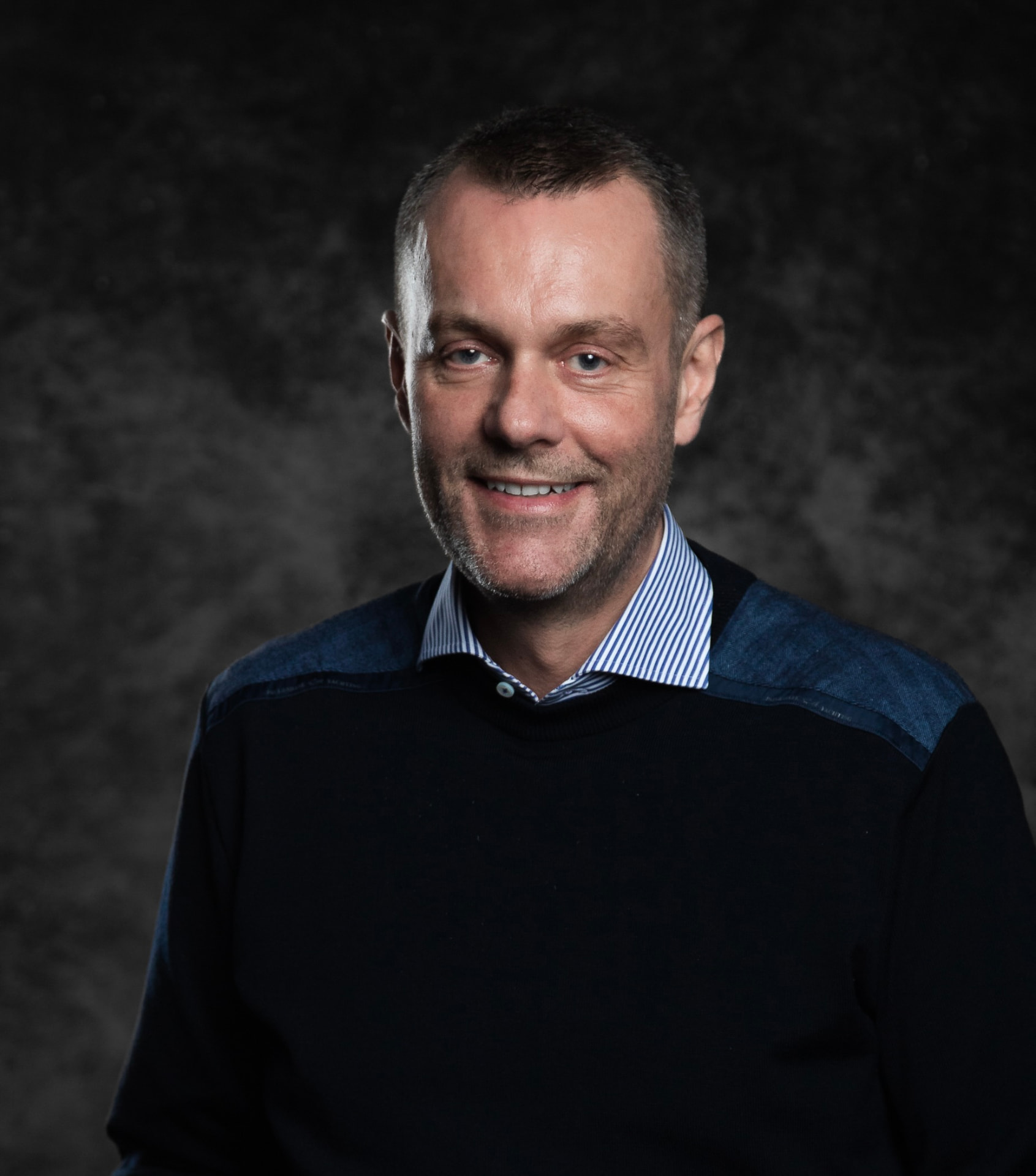
The Archivist
b. 1972
I am gathering the family's photographs, sources and stories before they disappear. This is why.
The middle name
My name is Øystein Lasse Tynning. My father is Åsmund Lasse. My grandfather was Lasse Tynning. My son, born in 2014, is called Lasse.
I have always known that the middle name meant something. Not exactly what, but that it was there for a reason, and that my father carried the same one. That was simply how it was.
Lasse was a family name we were fond of. Quite how dominant it had been in our history, we never knew.
When I started digging, I found out how far back it went.
The farm
Søndre Valler is not a history I read my way into. It is the farm where we brought the cows home, where I sat on the tractor with my father and played in the hay, and where I had my own small patch of soil and grew my own vegetables. We climbed the apple trees in the avenue and gathered apples for my mother's apple cakes. To a boy it was the most exciting playground in the world. The apple trees were older than all of us. They were what remained of a horticultural school that stood at Valler from 1909, and of an avenue of tall-stemmed apple trees planted along the road up to the farm.
I thought it was an ordinary farm, and that my grandfather had been an ordinary farmer. Only recently did I learn that the apple trees were his work, and that the whole field had once been full of them. The trees we climbed were what remained of Valler Gartneri.
My grandfather bought Valler in 1928 and moved in the same year. He came from a farm in Brekke in Ytre Sogn that he was the heir to, and that his brother later took over.
To me, Valler was the family farm. To him, it was the place where he began again.
The son
Long before I had children, I knew that if I had a son, he would be called Lasse Tynning.
That is where something shifts. For four hundred years the name had been passed down from father to son without anyone having to decide about it. In 2014 it was no longer something I inherited. It was something I chose.
And a name you choose is a name you ought to be able to tell the story behind.
Why an archive
My grandfather Lasse took a secret with him to the grave. There are photographs in the family that nobody can put names to any more. There are farms, letters and press cuttings that mean something only for as long as someone remembers why.
It is not dramatic. It happens in every family, quietly, over one or two generations.
This archive is an attempt to stop it happening to ours. I bring out photographs from the Vestland County Archive, read parish registers in the Norwegian Digital Archives, search old newspapers at the National Library, colourise portraits and turn what I find into podcasts. Not because our family is remarkable, but because it is ours.
The family archive
The archive connects the stories from Brekke, Søndre Valler, Lasse and Åshild to the people living today. The aim is not only to preserve names and dates, but to make the people themselves come alive for Lasse, Amund and those who come after.
Sources and uncertainty
Not everything on these pages is equally certain, and I try to say which is which.
Some of it is documented: deeds, censuses, parish registers and dated newspaper articles. Some of it is family lore, passed down and never checked. And some of it is guesswork, which I try to label as exactly that.
I would rather write that we do not know than fill the gap with something that sounds good. Stories that are too smooth tend to be too good to be true.
Contribute
If you have photographs, letters, recordings or memories that belong here, I would like to see them. The same goes for corrections: names I have spelled wrong, dates that are off, faces I have not managed to identify.
Nothing is too small. A name on the back of a photograph can be the thing that solves a puzzle.
The Builder
The plan in 1998 was to make enough money on a school party to afford a cruise. The cruise never happened. JCP happened instead, and after that more than a quarter of a century of building companies, teams and meeting places.
That may be the most family-like thing I have to offer. Nobody in this family ended up where they had intended. My grandfather left the farm he was meant to inherit. My grandmother Åshild was the eldest of thirteen at Haugland, a farm only one of them could inherit, and she became a teacher in Telemark. One of her brothers became a communist in the same municipality.
That is not why this site exists. But it may explain why the archive looks the way it does: schedules, sources, systems and a certain need to finish what I start.
As of 2025
Eleven companies. Around 200 full-time employees. Group operating revenue of close to 1.5 billion Norwegian kroner.
These figures are for the 2025 financial year and are not kept updated.
From Chateau Neuf to JCP
The story of JCP began on 10 October 1998. My plan was to earn enough from a school party at Chateau Neuf to go on a cruise. The cruise never happened. Instead the party, the sponsors and a new assignment for Tine led to Just Cruzin’ Production. What started with a few people and one idea grew into a communications house working in events, PR, retail, travel, its own event concepts and production.
10 October 1998
Back to school party, Betong at Chateau Neuf
The sponsors wanted more — and JCP was born
Building through headwind
The road has not been growth alone. The Nordic expansion brought both experience and a demanding Swedish setback. When the pandemic closed the possibility of gathering people in 2020, much of the market disappeared almost overnight. JCP had to lay off most of its employees and take tough measures. That the company kept its expertise and later returned to record activity has become an important chapter in a story about culture, responsibility and endurance.
An honest full stop after thirteen years of investment.
77 of 87 employees were temporarily laid off in the first phase of the crisis; management took part in the measures too.
The event business expected a record year after two very demanding years.
The figures are historical and taken from the sources at the foot of this page. They do not describe today's organisation.
Companies and commitments
JCP and WAL are the two most important ventures I have founded. My other roles span experiences, advertising, media, travel, leadership development and technology. These are the main commitments — not a full legal list of board positions.
Founder and Executive Chairman
A communications house with teams in events, PR, retail, travel, arenas and production. JCP was started in 1998 and is the main work of my professional life.
Visit the websiteJCP (external link, opens in a new tab)Founder, co-owner and board member
An independent, employee-owned agency for advertising, media, content, design and events, started in 2014. WAL is one of my two most important ventures.
Visit the websiteWAL (external link, opens in a new tab)Chair of the board
The industry association works to develop the sponsorship and event profession and is behind the annual Sponsor and Event Award.
Visit the websiteSponsor- og Eventforeningen (external link, opens in a new tab)Chair of the board, SHE Conference AS
A commitment to social sustainability, diversity, inclusion and meeting places that can create change.
Visit the websiteSHE Conference (external link, opens in a new tab)Chair and co-owner through the JCP community
Leadership and business development rooted in elite sport, coaching and performance culture.
Visit the websiteOrdtilhandling (external link, opens in a new tab)Chair of the board
Software for project economics, targets, forecasts and continuous management information — built to make complex businesses easier to steer.
Visit the websiteHQ Live (external link, opens in a new tab)Other board positions
Meeting places for families
Through JCP Arena, I help develop owned concepts and free meeting places. A Walk in the Park is a travelling family festival, while SnøFønn brings the same idea into the winter season. The common thread is that children and families should be able to take part without having to buy anything.
From Betong to Cannes
In March 2026 JCP won the Grand Prix at the Heavent Awards in Cannes for “The Brevik Experience”, made together with Heidelberg Materials Norway. The project communicated the opening of the world's first full-scale carbon capture plant in the cement industry. JCP also won gold for a project with SpareBank 1 and silver for the Brevik project. From a school party in the basement of Chateau Neuf to an internationally awarded telling of Norwegian industrial history runs one clear line: the ambition to make people care.
How I work
In the podcast Event Talk, I talk about leading when everything is on fire, from a power failure just before a concert at Oslo Spektrum to the pandemic and major market shifts. I put great weight on good run-throughs, preparation and meeting problems head on. At the same time, the event profession is for me something fundamentally human: creating encounters that engage and are remembered.
Power failures, Spektrum and steady control — with Øystein Tynning
Event Talk / Checkin · 11 May 2026 · 55 min
On the start in 1998, leadership, systems, perfectionism and more than two decades of change in the event industry.
Selected in the media
2026 · Event Talk / Checkin
Det mest personlige intervjuet om gründerreisen, systemer, kriser og ledelse.
2026 · Kampanje
Om JCPs største internasjonale eventpris og prosjektet fra Brevik.
2026 · Kampanje
Jubileumskommentar av Øystein Tynning og Bodil Sveen Berggren om sponsor- og eventfagets utvikling.
2022 · Finansavisen
Om JCPs sterke tilbakekomst etter to svært krevende pandemiår.
2020–2021 · Kampanje
To samtidige artikler dokumenterer permitteringene, krisetiltakene og arbeidet med å holde på mennesker og kompetanse.
2010 · Kampanje
Et tidsbilde fra overgangen fra rent eventbyrå til et bredere kommunikasjonshus.
This overview collects selected press and online articles about Øystein Tynning, JCP and professional engagement from the start in 1998 to the present. The sources show the development from start-up phase and growth, through difficult choices and the pandemic, to industry engagement and newer initiatives.
The overview is based on open online and media sources. Older newspaper coverage from the first years after 1998 can be supplemented by searching the National Library's newspaper collection and Retriever.
Professional roles change over time. The information on this page was checked against public and official sources in September 2026. Family details come from the family archive.